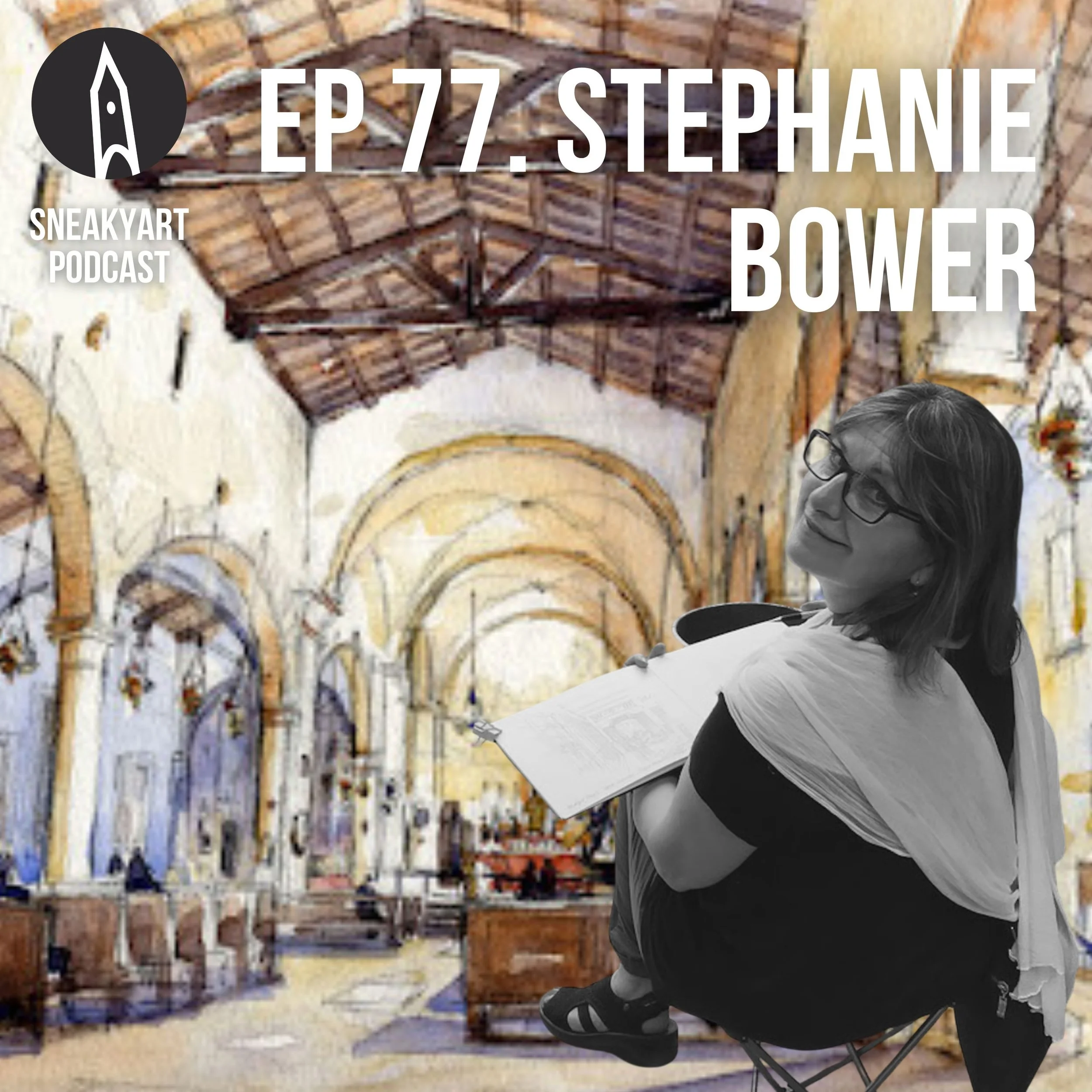
Architect, teacher, and author of multiple Urban Sketching books, Stephanie Bower does not like to be called an artist. At some point, this conversation addresses how Imposter Syndrome never really lets go of us. Stephanie illustrates the serendipitous journey of her life, from architect to illustrator and traveling the world with her sketchbooks. From one open door to the next, runs a common thread - the desire to learn and the passion to teach others.
🙌🏽 [Buy] Stephanie Bower’s books on urban sketching, and [Follow] her on IG.
☕️ [Like] this episode? Buy me a coffee!
📫 [Sign up] to Nishant’s Substack newsletter, or [Follow] Sneaky Art on IG
📚 [Buy] Nishant’s book: Make (Sneaky) Art
💻 [Read/Listen] for the full show-notes + bonus segment of this conversation.
Find below a bonus segment of this conversation, where Stephanie asks Nishant additional questions from her reading of Make (Sneaky) Art. Nishant shares how he approaches his creative practice, especially the importance of maintaining a degree of creative naivete.
Where does one draw the line between knowing as much as possible, and not letting knowledge discourage us from the doing of creativity?
Stephanie asks why people post on social media, and Nishant speaks about a recent favourite book - Psychopolitics by Byung-Chul Han, where the author argues that social media functions like a panopticon. They discuss how feeds compel us to police our own behaviours and expressions, and what the author describes as “the tyranny of the like button”.
“When a measure becomes a target, it ceases to be a useful measure.” - Goodhart’s Law
On the crisis of social media, Nishant speaks about how social media metrics offer an easy way to determine value, but that this automatically makes it a terrible way to determine value. This is esp true for subjects that do not quantify easily, like artistic merit and creative expression.
Stephanie weighs writing a fourth perspective book versus making video content, noting that writing makes little to no money when weighed against the effort put in, whereas an online course can generate revenue directly for the creator.
On the value of making art in the age of AI, Nishant refers to Walter Benjamin’s "The Work of Art in the Age of Mechanical Reproduction”, where the author debates the purpose of art in an age where it is rapidly losing “aura”. Nishant shares how he has arrived at the conclusion that art, in order to hold its value, needs to emphasize its humanity. This means limitations and constraints, mistakes and irreproducible properties, stories, individuality, and honest expression.
Nishant wrote about his thoughts and impressions of Benjamin’s work in a multi-part series on his Substack. Read here: The Role of Art in the Age of 'Virtual Reproduction' | The Concept of Aura | What is Art keeps changing | Free Contemplation of Art | Freewriting | Everyone should own art
Supplement these ideas with essays by John Berger in Ways of Seeing.
Book List from the Episode
"101 Sketching Tips" by Stephanie Bower
"Understanding Perspective" by Stephanie Bower
"The World of Urban Sketching" by Stephanie Bower
"Make (Sneaky) Art: and other good ideas to build a sketchbook habit" by Nishant Jain
"Invisible Cities" by Italo Calvino
"The Enchantress of Florence" by Salman Rushdie
"Victory City" by Salman Rushdie
"Steps to Water" by Morna Livingston
"The Work of Art in the Age of Mechanical Reproduction” by Walter Benjamin
“Psychopolitics” by Byung-chul Han
“Ways of Seeing” by John Berger
Stay in touch with Nishant’s writing by adding Sneaky Art to your inbox.