On recent visits to Europe and India, I was a little taken aback to see the casual adoption of AI in marketing, research, and writing. The publishing industry in India, particularly, seems to have few qualms about AI in books. I was a speaker at Jaipur Literature Festival this month, spending time at the Author’s Lounge with other writers, publishers, and speakers over the 5-day festival. The question of AI came up a few times. Not enough, though.
I am not sure why people walk on eggshells around this subject. Maybe they do not know which stance to take. But I am clear on where I stand, and I come to this view from multiple fronts. I articulated these ideas for the first time just over 2 years ago, when AI first became a hot-topic in pop culture. Below, I share these ideas, and how they have developed since:
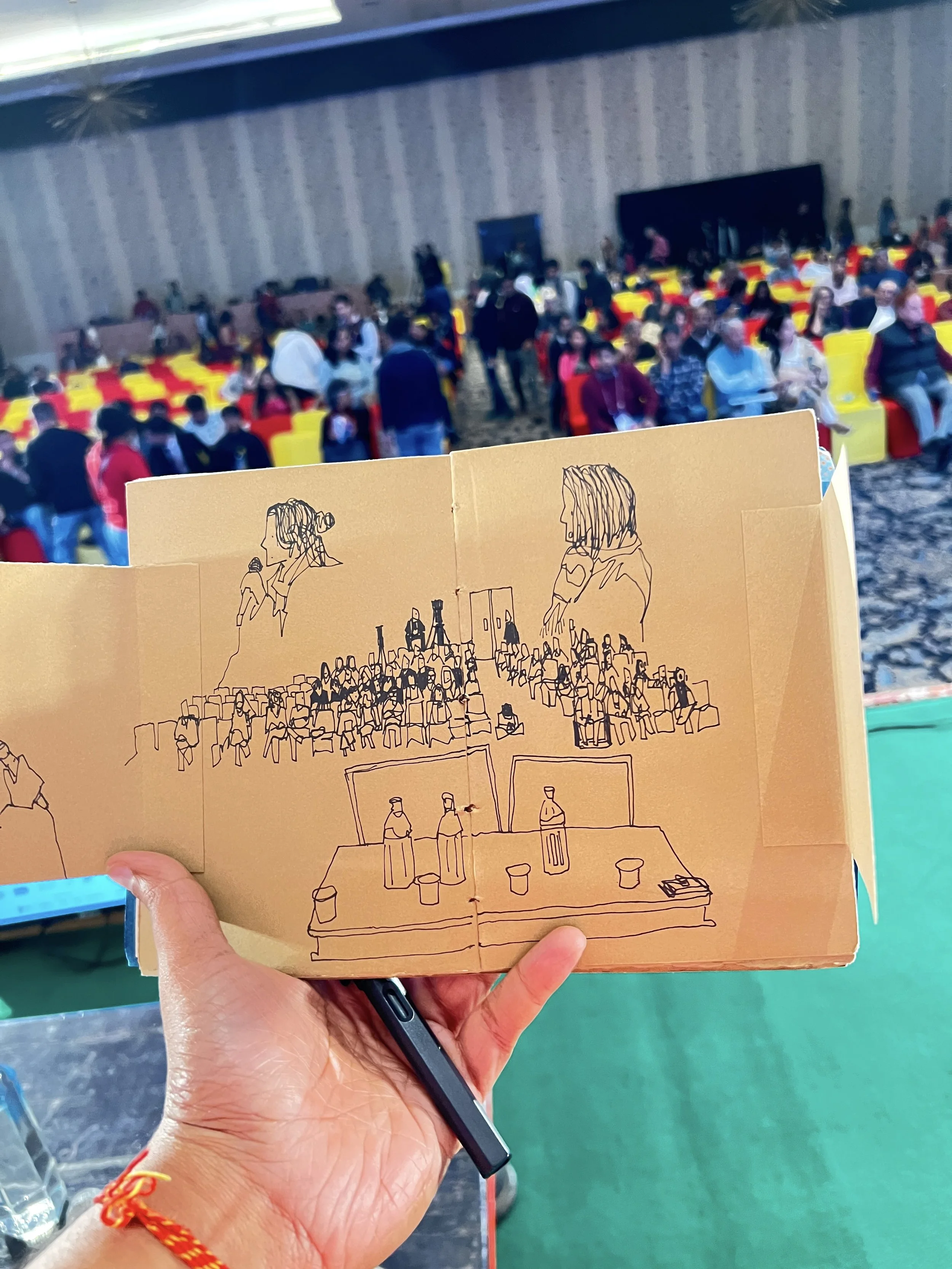
Drawing onstage during my first panel at JLF
Do not call it AI Art
It is laughable how easily techbros started using the phrase “AI Art”. Actual artists, despite great skill and validation from people around them, hesitate for years before accepting the word “artist”. Calling your own work “art” requires courage, a lot of which is dedicated to standing up to one’s own Imposter Syndrome. But why would you have Imposter Syndrome when being an Imposter is the whole job? The tech industry does not hesitate because AI Art (like AI Writing) is a marketing term that guarantees billions in funds.
There is no hesitation because there is no introspection. There is no introspection because there is no sense of self v others. There is no such sense because there is no self in AI. Who makes art is a good question, but a better question is why we make art. And, why do we care about art?
Why they call it that
It is important to see why they call it AI Art, when it has no function besides filling up the infinite feeds faster than anything before. AI Content would be a more accurate term, but the word Content does not hold the same cultural capital. And cultural capital matters.
From my post, Art and Artificial Intelligence, in Dec 2023:
Here is a definition of colonialism:
To extract the value from a stolen thing without caring for how it was made or by whom, even at the cost of its destruction. To not care about what you destroy, because it was never yours, as long as you can squeeze every drop of its worth.
To call the destruction a tragedy, and the profits an inevitable necessity.
We are in the middle of a period of cultural colonization. It is being presented as an inevitability.
As the digital landscape becomes better defined, the colonizers have laid first claim to everything. Everything that is produced, everyone that exists, every transaction, exchange, and communication that occurs. Our digital lives (and our digital selves) are nearly inseparable from our real lives (and real selves). Therefore, to live with freedom and prosperity, we need Digital Human Rights that are at least equal to basic human rights. Instead, we live under a Digital Feudalism that threatens to leak into real-world feudalism.
AI does not bring equality. It reinforces feudalism by forcing the creative process to pass through tollbooths set up by a handful of Silicon Valley billionaires.
The job of AI Content
The job of AI Content is to legitimize the theft of all creative work anywhere on the planet. The job of AI Content is to force all creative work to submit to, and seek the approval of, AI overlords. The job of AI Content is to brute-force everyone to work for the algorithms that run infinite feeds of slop that shatter our attention spans and monetize the shards for corporations running ads. The job of AI Content is to run this assembly line faster than ever, faster everyday.
It reduces you from active human to a passive agent with eyeballs that are worth a few cents per second of ad-time.
Resist.